
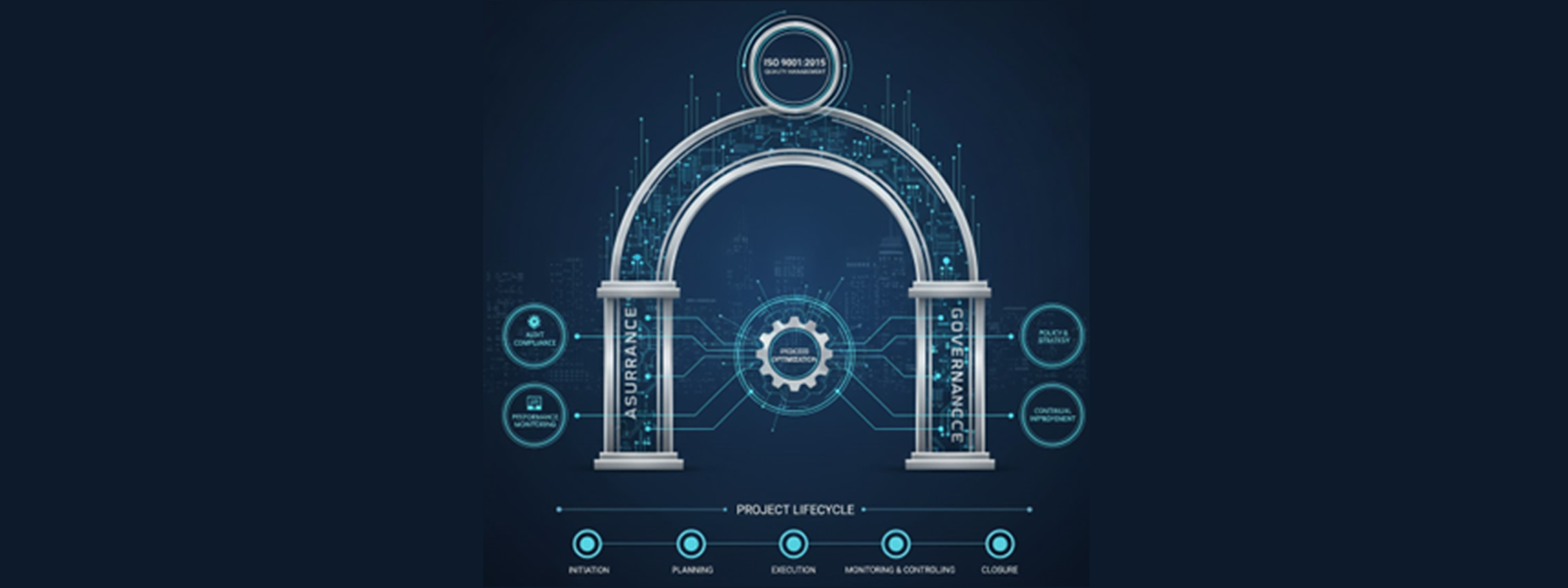
The architectural backbone of Assurance: Integrating ISO 9001 into Project Quality Governance
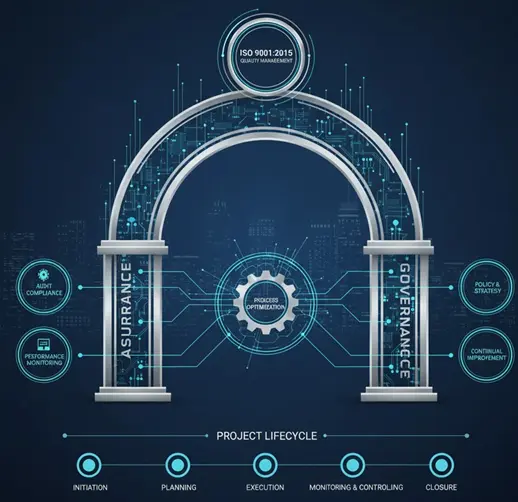 Quality and assurance are interdependent concepts essential to the business world. In the complex ecosystem of project delivery, the assurance function serves as the critical mechanism for verifying compliance, validating performance and mitigating risk. While often perceived as a certification mandate, the ISO 9001:2015 Quality Management System (QMS) standard provides a robust, process-oriented framework that, when strategically integrated, elevates project assurance from a reactive audit to a proactive, systemic governance function.
This article deconstructs the core tenets of ISO 9001 to demonstrate its intrinsic value in establishing a standardised, evidence-based and continuously improving assurance practice across all project domains from construction and manufacturing to software development and Research and Development.
1. Deconstructing the synergy: Assurance and the QMS
Project assurance is defined as the systematic process of providing confidence to stakeholders that a project will meet established objectives and standards. ISO 9001, conversely, provides the framework for a QMS based on the Demining: Plan-Do-Check-Act (PDCA) cycle and a risk-based thinking approach. The confluence of these two disciplines creates a powerful synergy: the QMS defines the what and how of an organisation's quality processes, while the assurance function provides the independent verification that these processes are being followed and are effective within the project context.
For all participants from project managers and engineers to software developers and quality auditors this integration means assurance is not an external imposition but an integral part of the project's operational fabric.
2. The ISO 9001 clauses as a technical framework for project assurance
The technical rigor of ISO 9001 provides a structured methodology for executing the assurance function. Its key clauses map directly to critical assurance activities.
2.1. Context and leadership (clauses 4 and 5): Strategic alignment assurance
Before a single deliverable is produced, assurance must begin at the strategic level.
- Clause 4.1 and 4.2: Understanding the organisation and stakeholder needs forces the project and assurance teams to formally identify and document relevant requirements, standards and regulatory frameworks. This forms the foundational benchmark against which all assurance activities will be measured.
- Clause 5.1 and 5.2: Demonstrated leadership and a customer focus ensure that the project's quality policy and objectives are aligned with business strategy. The assurance function can then audit against this policy, verifying that project decisions are made with the end-user and business value in mind, not just interim deliverables.
2.2. Planning (clause 6): Risk-based assurance scoping
ISO 9001’s emphasis on risk-based thinking is its most significant contribution to modern assurance.
- Clause 6.1: The requirement to address risks and opportunities provides a mandate for the assurance function to move beyond compliance checking. It necessitates a formal Risk Register and a methodology for prioritising assurance activities based on the highest risks to project objectives (e.g., technical complexity, supplier capability, safety-critical functions).
- Clause 6.2: The establishment of measurable quality objectives at relevant functions and levels gives the assurance team clear, quantifiable metrics for success. Instead of asking "Is the process being followed?", assurance can now ask "Is the process achieving its intended outcome (e.g., <2% defect rate, >95% on-time delivery from suppliers)?"
2.3. Support and operation (Clauses 7 and 8): Process and conformance assurance
This is the execution core, where the QMS provides the standardised toolkit for the project.
- Clause 7.1-7.2: Requirements for competent personnel, suitable infrastructure and a controlled documented information environment ensure the project team operates from a validated baseline. The assurance function audits this ecosystem, confirming that team members are qualified, calibrated equipment is used and the correct versions of plans and specifications are accessible.
- Clause 8.1-8.5: These clauses cover operational planning and control, including design and development, externally provided processes, and production. For assurance, this translates into a mandate to verify:
o Design controls: Are design reviews, verification and validation activities being conducted as planned?
o Supplier management: Is there evidence of robust supplier evaluation and incoming inspection?
o Traceability: Is the project maintaining records that allow the journey from requirement to deliverable to be traced?
2.4. Performance evaluation and improvement (Clauses 9 and 10): The assurance feedback loop
This is where the PDCA cycle closes, transforming assurance from a policing activity into a catalyst for improvement.
- Clause 9.1: The requirement for monitoring, measurement, analysis and evaluation provides the technical basis for evidence-based assurance. This includes everything from tracking Key Performance Indicators (KPIs) and conducting internal audits to analysing customer satisfaction and non-conforming outputs.
- Clause 9.2 and 9.3: The formal processes for internal audit and management review create the governance rhythm. The assurance function feeds its findings directly into these forums, providing objective data for strategic decision-making by the project board.
- Clause 10: The imperative for continual improvement, driven by corrective action (addressing root causes of non-conformities), ensures that assurance findings are not just recorded but are acted upon. This closes the loop, preventing the recurrence of issues and systematically enhancing the project's delivery capability.
3. Practical integration: The assurance dashboard as a QMS artifact
A tangible output of this integration is a standardised Project Assurance Dashboard. This is not merely a status report but a live QMS artifact that embodies multiple clauses. It would display:
- Performance against objectives (Clause 9.1): Charts tracking KPIs like schedule variance, cost performance index and defect density.
- Risk Register Health (Clause 6.1): Status of top risks and the effectiveness of mitigation actions.
- Non-conformance tracking (Clause 10.2): A live log of deviations, their root causes and the status of corrective actions.
- Audit results (Clause 9.2): Summary findings from recent process audits.
This dashboard becomes the single source of truth for the project's health, providing objective evidence for management review (Clause 9.3) and enabling data-driven interventions.
4. Conclusion: From certificate to competitive advantage
Viewing ISO 9001 solely as a certification to be achieved is a profound underutilisation of its capability. For the project assurance function, it provides an internationally recognised, systematic, and technically robust architecture. It replaces ad-hoc checks with a disciplined, process-based approach grounded in risk-based thinking and evidence-based evaluation.
By embedding the principles of ISO 9001 into the assurance lifecycle, organisations can ensure that their projects are not only compliant but are also more predictable, efficient and capable of delivering superior quality outcomes. It transforms the assurance function from a necessary overhead into the central nervous system of project quality and a genuine source of competitive advantage.
Author:

Rashid Menhas (B.Eng., MS-Res Eng. Mgt.) is a Quality Management Professional at BAE Systems Strategic Aerospace Services (BSL) Qatar.
He is also an active volunteer with the Assurance Interest Network at APM.
You may find these other resources of interest
- APM Body of Knowledge Chapter 3 - Assurance
- APM Body of Knowledge Chapter 5.3 - Quality Assurance
- Guide to Integrated Assurance Management
APM members can claim 10% discount on paperback publications by using code APMMEM10 at checkout.
Join the APM Learning group to read updates on learning resources